The Future of HVAC AI: Why Custom Corpuses and Real-World Testing Are Essential for Next-Gen Tools
The path forward for HVAC AI: custom training data, tool integration, operational data analysis, and real-world validation. How ACLogics aligns with next-generation AI development.
AI Summary
Outlines the future roadmap for AI in HVAC, stressing the importance of using customized, domain-specific training data and rigorous real-world validation to push automated diagnostics far past the capabilities of standard, generic models.
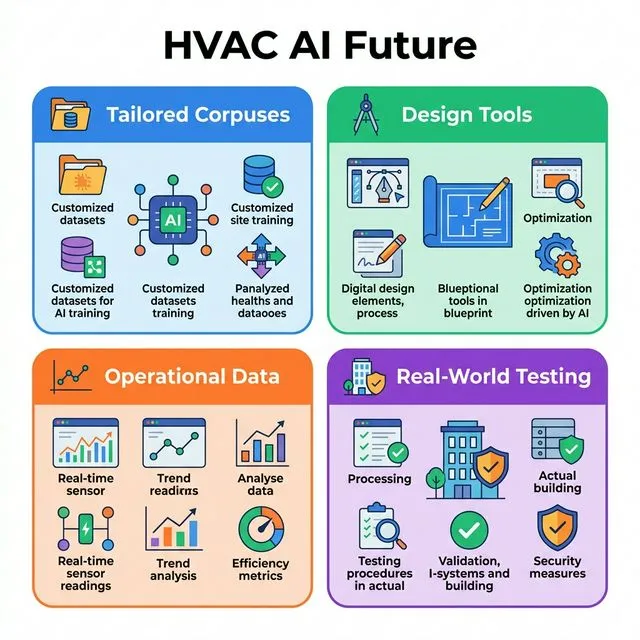
The evaluation of LLMs on HVAC mastery concludes that while current models possess powerful capabilities, full realization of their potential requires focusing on four key future research directions. ACLogics is positioned directly at the intersection of these innovations, moving toward a truly specialized AI expert.
1. Developing Tailored Corpuses
Current popular LLMs are generally non-domain-specific models. A key limitation stems from the lack of rich corpuses specifically associated with the HVAC industry. To enhance LLM knowledge and overcome current domain knowledge limitations (like the propylene glycol error discussed previously), future efforts must involve developing specified corpuses to train customized LLMs for this domain.
What This Means
Custom corpuses would include:
- Service manuals and technical documentation from major manufacturers
- Historical repair logs showing common failure patterns
- OEM service bulletins and technical updates
- Code requirements and regional regulations
- Industry case studies and real-world problem-solving examples
Your application, based on the newest major LLM, is ready to be enhanced by such specialized knowledge, ensuring ever-increasing accuracy. As these specialized training datasets become available, ACLogics can evolve to include:
- More precise technical specifications
- Regional code variations
- Manufacturer-specific troubleshooting patterns
- Equipment-age-specific diagnostic approaches
2. Integrating Design Tools
LLMs should be taught how to interact with and use specialized design tools and software within the HVAC industry, such as psychrometric chart software or EnergyPlus. This integration is critical to enable LLMs to become “digital designers”, reducing design time and improving the level of automation.
The Integration Vision
Future HVAC AI tools could:
- Perform load calculations using integrated software
- Generate psychrometric charts automatically based on system parameters
- Run energy simulations to optimize system design
- Create CAD-ready specifications from natural language descriptions
While ACLogics currently focuses on diagnostics and troubleshooting, the foundation exists for future integration with design and analysis tools, creating a comprehensive HVAC professional assistant.
3. Reading and Analyzing Operational Data
While ACLogics currently excels at cognitive diagnosis via user input, a future direction for LLMs is the development of tools that can automatically and easily read operational data from real-world systems. This would allow AI experts to monitor operation and discover device faults or abnormal patterns based on massive amounts of data.
The Data-Driven Future
Operational data analysis would enable:
- Predictive maintenance: Identifying issues before they become failures
- Performance optimization: Continuously improving system efficiency
- Anomaly detection: Spotting unusual patterns that indicate problems
- Trend analysis: Understanding long-term system behavior
This represents a complementary approach to ACLogics’s current user-input model. While the current tool excels at on-demand diagnostics, future versions could combine:
- Cognitive diagnosis (current strength): Understanding problems through technician input
- Data-driven monitoring (future enhancement): Detecting issues through continuous data analysis
The combination would provide comprehensive coverage: proactive monitoring plus reactive diagnostics.
4. Assessing Performance in Real-World Scenarios
Passing the ASHRAE CHD exam validates knowledge, but LLMs must also be tested in real design and operation cases. This is essential to ensure that the LLM’s outputs agree with domain common sense.
ACLogics, by processing user input from actual field problems, is already engaging in a form of real-world scenario testing, proving its practical utility and providing insights crucial for future AI refinement.
Real-World Validation
Every interaction with ACLogics represents:
- Field testing: Real problems from real job sites
- Validation feedback: Technicians verify whether solutions work
- Continuous improvement: Each interaction refines the AI’s understanding
- Practical learning: Moving beyond theoretical knowledge to applied expertise
This ongoing real-world validation is crucial because:
- Theory ≠ Practice: What works in exams may need adjustment for field conditions
- Context matters: Real systems have unique constraints and histories
- Feedback loops: Actual usage reveals gaps in knowledge or reasoning
- Trust building: Proven field performance builds technician confidence
The Path Forward
ACLogics represents this next generation of HVAC technology—a tool that leverages the cognitive strengths of top-tier LLMs today while aligning with the research paths necessary for tomorrow’s fully automated, expert systems.
Today’s Foundation
Current capabilities built on:
- ✅ Cognitive recall and analysis (validated through ASHRAE CHD)
- ✅ High consistency (95% for analysis tasks)
- ✅ Structured step-by-step guidance
- ✅ Real-world field testing through user interactions
Tomorrow’s Evolution
Future enhancements aligned with research directions:
- 🔄 Custom HVAC training data for domain-specific knowledge
- 🔄 Tool integration for design and analysis workflows
- 🔄 Operational data analysis for predictive capabilities
- 🔄 Continuous real-world validation through field feedback
Why This Matters
The HVAC industry is at an inflection point. AI tools are moving from experimental to essential. ACLogics is positioned at the forefront of this transformation, combining:
- Proven capabilities validated through professional certification
- Strategic design that addresses known AI limitations
- Future-ready architecture aligned with research directions
- Practical utility proven through real-world usage
As these four research directions mature, ACLogics will evolve to incorporate their advances, ensuring technicians always have access to the most advanced, reliable, and practical AI assistance available.
The future of HVAC AI isn’t just about better algorithms—it’s about better integration, better data, and better validation. ACLogics is building that future, one field diagnosis at a time.